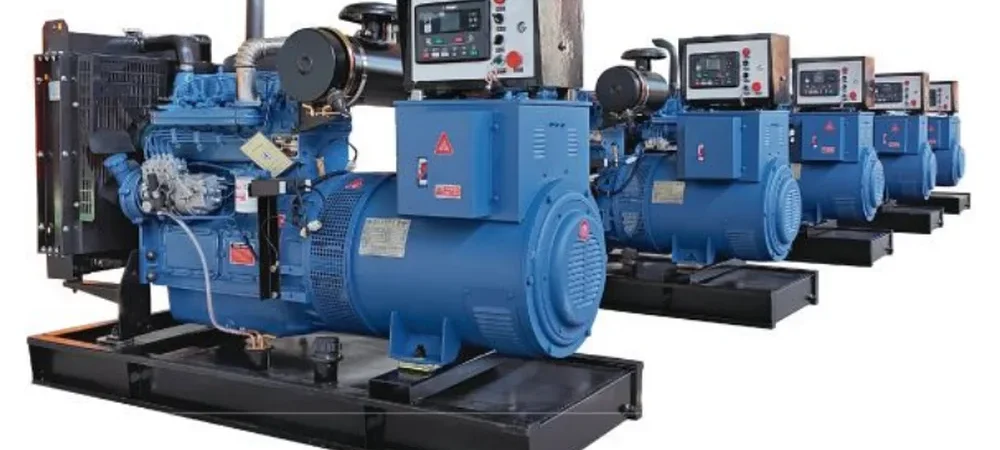
Buying a diesel generator starts with one question: how many kW do you actually need? Choose too small and the set overloads, trips, or fails to start your motors. Choose too large and you pay for capacity you never use and run the engine at light load. This guide explains prime power versus standby power, gives a practical sizing method, and shows the range available from Huailite Power — diesel generator sets from 8 kW to 3000 kW, all 50 Hz, 1500 rpm, 400 V, power factor 0.8 lagging, three-phase four-wire.
Short answer
Size on prime power if the set is your main supply, and on standby power only if it is backup for the grid. Add up the running kW of everything that runs at the same time, add the starting surge of the largest motor, add a margin — then check fuel consumption, weight, dimensions, and rated current on the product page. The range runs 8–3000 kW, all 50 Hz, 1500 rpm, 400 V.
Prime Power vs Standby Power: the Difference That Decides Everything
Every generator set in our catalogue carries two ratings: prime power and standby power. They are not two ways of saying the same thing.
Prime power is the power the set can deliver continuously as your main source of electricity — for example, on a construction site, a remote telecom station, or a facility with no grid connection. Standby power is the power the set can deliver during a mains outage, as emergency backup for a limited time. Standby power is always the higher number: for example, Yuchai sets run to 2400 kW prime and 2600 kW standby, and Weichai sets run to 3000 kW prime and 3000 kW standby.
The rule is simple: size on prime power if the generator is your main supply, and on standby power if it is backup for the grid. Buying a set rated 100 kW standby and running it as a 100 kW prime supply is an oversizing error in reverse — it will be overloaded in continuous service.
One honest note: in the supplier catalogue, some rows print only one of the two ratings and leave the other cell blank. Where a cell is blank, we leave it blank on the product page rather than guessing. Always check both columns on the product page before you order, and ask us if the rating you need is not printed — contact our sales team with the model and engine.
How to Size a Generator in Five Steps
1. List every load the set must carry
Write down every load: lighting, air conditioning, pumps, compressors, motors, chargers, and site tools. For each one, note its running kW and whether it starts at the same time as the others.
2. Add up the running load
Add the running kW of everything that runs at the same time. This is your base load. Loads that never run together do not need to be added — but be realistic about overlap on a busy site.
3. Add the starting surge of the largest motor
Electric motors draw several times their running current when they start. A pump or compressor starting under load can briefly demand far more than its nameplate kW. Add the starting surge of the largest motor to your base load, and check the set’s rated current (A) on the product page against the motor’s starting current.
4. Apply a margin, not a guess
Add a sensible margin for future loads and for the fact that real sites grow. A set running permanently at 100% of its prime rating leaves no room for anything new. Most buyers size so the normal load sits comfortably below prime power — the exact margin depends on your load profile, so send us your load list and we will check it against the catalogue.
5. Check the rest of the specification, not just kW
kW is only the first filter. Before you confirm a model, check these on the product page:
- Fuel consumption (g/kW.h) — the running cost over the life of the set
- Gross weight (kg) and dimensions (L × W × H mm) — transport, foundation, and room space
- Engine model, cylinder count, bore × stroke, and displacement — the engine behind the rating
- Rated current (A) — for breaker and cable sizing
- 1-hour power (kW) — the short-term overload rating printed for the set
What Comes as Standard — and What Is Optional
Every open-type generator set in our range ships with the same standard equipment: diesel engine, starting batteries and battery connection wires, a 40 °C water-cooled radiator, silencer and flexible exhaust hose, alternator, output circuit breaker, digital control panel, and steel base frame.
Optional equipment available across the range includes a soundproof enclosure, ATS (automatic transfer switch), a 50 °C water-cooled radiator, a water heater, and an automatic parallel synchronising control system. If your site needs soundproofing, start with our soundproof, container and mobile trailer sets.
Sizing Examples From the Catalogue
- Small site or telecom load, 8–50 kW prime: Isuzu sets cover 8–50 kW prime and Yanmar sets 10–50 kW prime — compact sets for small loads, with standby ratings up to 60 kW.
- Workshop or mid-size site, 50–500 kW prime: DCEC sets cover 10–450 kW prime, Doosan 50–800 kW prime, and Volvo Penta 80–600 kW prime.
- Large site or plant, 500–3000 kW prime: Weichai sets run to 3000 kW prime, Yuchai to 2400 kW prime, SDEC to 1800 kW prime, Perkins to 1800 kW prime, and CCEC to 1500 kW prime.
- A starting point for comparison: our 100 kW prime models are available with Ricardo, SDEC, DCEC, CCEC, Weichai, Yuchai, Perkins, and Volvo Penta engines — the same 100 kW, eight different engines. See the full range on the Generator Sets page.
Common Sizing Mistakes to Avoid
- Sizing on standby power for a prime-power job. Standby is a higher number for a reason — it is not continuous duty.
- Forgetting motor starting current. A set that covers the running load can still trip when the largest motor starts.
- Ignoring fuel consumption. Two sets with the same kW can have very different fuel consumption rates — check the g/kW.h column before you choose.
- Forgetting the physical size. A 3000 kW set weighs and measures far more than a 100 kW set. Confirm weight and dimensions against your transport and foundation limits.
- Ordering from the model number alone. Model numbers repeat across engine brands in this catalogue — HH100GF exists with Ricardo, SDEC, DCEC, Weichai, Yuchai, Perkins, and Volvo Penta engines. Always confirm the engine model as well as the set model.
| Engine series | Model | Engine | Prime power | Standby power | Apparent power |
|---|---|---|---|---|---|
| Perkins | HH100GF | 1106A-70TG1 | 100 kW | 120 kW | 125 kVA |
| Volvo Penta | HH100GF | TAD750GE | 100 kW | – | 125 kVA |
| Yuchai | HH100GF | YC4A165-D30 | 100 kW | – | 125 kVA |
| Weichai | HH100GF | WP4.6ND120E310 | 100 kW | 120 kW | 150 kVA |
| CCEC | HH100GF | QSB3.9-G39 | 80 kW | 100 kW | 125 kVA |
| DCEC | HH100GF | 6BTA5.9-G2 | 100 kW | – | 125 kVA |
| SDEC | HH100GF | SC4H180D2 | 100 kW | 120 kW | 125 kVA |
| Ricardo | HH100GF | HHR6105AZLD | 100 kW | – | 125 kVA |
Frequently Asked Questions
What is the difference between prime power and standby power?
Prime power is the rating for continuous use as the main power source. Standby power is the higher rating for emergency backup during a mains outage. Size on prime power for continuous duty and on standby power for backup duty.
How do I calculate the kW I need?
Add up the running kW of all loads that operate at the same time, then add the starting surge of the largest motor, then add a margin for future loads. Send the load list to our sales team and we will check it against the catalogue ratings.
What voltage and frequency are your generator sets?
All sets in the range are 50 Hz, 1500 rpm, 400 V, power factor 0.8 lagging, three-phase four-wire.
Do you publish prices for generator sets?
No. All products are B2B and priced per project. Request a quote with the model, engine, quantity, and your load details, and we will quote for your project.
—
*Browse the full range on the Generator Sets page or shop all products.*