Short answer
Use a mesh sock grip for ACSR120–720 and a mesh sock joint for larger conductors up to ACSR1250, and size the swivel to the pulling tension — the SLX family covers 5 to 80 kN and the SL family 130 to 320 kN. Every link in the rope–swivel–sock–conductor chain must be rated at or above the maximum pulling tension.
Introduction
Stringing a conductor means pulling kilometres of wire through stringing blocks under tension, across tower after tower. The pulling machine and the blocks get most of the attention, but the connection between the pulling rope and the conductor itself is made by three small parts: a mesh sock that grips the conductor, a swivel that joins the sock to the rope, and — on larger conductors — a heavier sock joint. Get any one of them wrong and the pull either damages the conductor or stops halfway through the section.
This guide explains what each of the three does, how they work together, and how to pick the right model from the range listed on Huailite Power. Every number below comes from the parameter tables on the product pages; prices are quoted per customer and project, not listed online.
The swivel: it stops twist from reaching the conductor
A pulling rope twists as it is wound, unwound and dragged through blocks. If that twist is passed straight into the conductor, torsion strain accumulates in the wire over the length of the pull. The swivel sits between the rope and the sock so the two sides can rotate independently: the rope can twist without twisting the conductor.
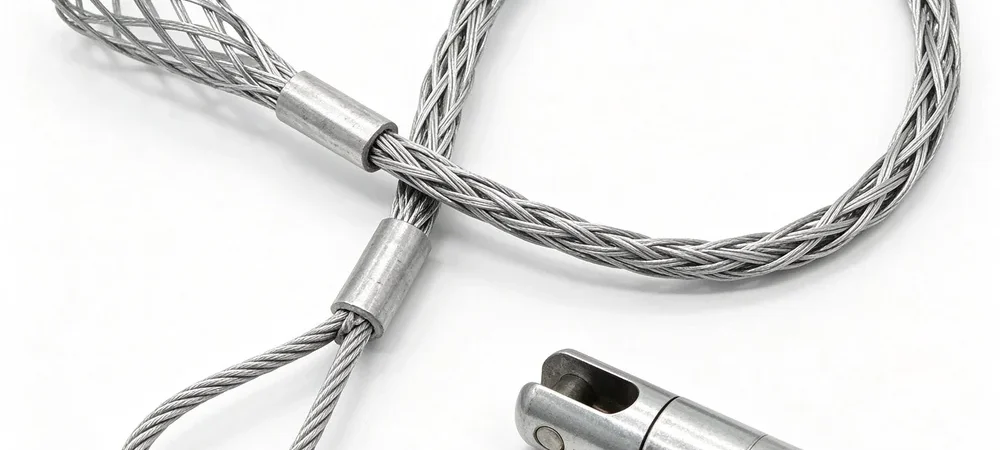
The product description on the SLX-0.5 page states the use plainly: “to connect the pulling rope to the mesh sock joint mounted on the conductor, designed to avoid torsion strain accumulation.” That is the whole job — it is a connector that rotates, not a pulling device, and it carries the full pulling tension while it does it.
The Line Stringing Swivel series covers 11 models in two families. The SL family is the heavy end: SL130 rated at 130 kN, SL180 at 180 kN, SL250 and SL250Y both at 250 kN, and SL320 at 320 kN. The SLX family is the light end: SLX-1 at 10 kN, SLX-2 at 20 kN, SLX-3 at 30 kN, SLX-5 at 50 kN, SLX-6.5 at 65 kN and SLX-8 at 80 kN. Below them sits the smallest model, the SLX-0.5, listed on its own page at a 5 kN rated load and 0.2 kg.
Two things in the table deserve attention. First, the same rated load does not mean the same swivel: the SL250 weighs 10.6 kg and the SL250Y weighs 8.0 kg, both rated at 250 kN, with different dimensions — check the A–E dimensions on the product page against your rope and sock fittings before choosing between them. Second, size the swivel to the pulling tension, not to the conductor: the swivel never touches the conductor, so its only selection rule is that its rated load must cover the maximum tension of the pull, with margin. A swivel rated below the pulling tension is the weakest link in the whole string.
The mesh sock grip: it holds by friction, not by crushing
The mesh sock grip is a woven steel sleeve that slides over the end of the conductor. When tension is applied, the weave tightens around the wire — the harder the pull, the tighter the grip — so it holds without clamps, bolts or anything that crushes or dents the strands. That matters because a dented strand is a weak point for the life of the line.
The Mesh Sock Grip series lists five models, and the selection rule is the conductor size. The table matches each model to an ACSR conductor range: SLW(S)-2 fits ACSR120-150, SLW(S)-2.5 fits ACSR185-240, SLW(S)-3 fits ACSR300-400, SLW(S)-4 fits ACSR500-630, and SLW(S)-5 fits ACSR720. Pick the model whose range contains your conductor — a sock sized for a smaller conductor will not go on, and one sized too large will not grip properly.
Each model prints two loads. The rated load is the working limit: 20 kN on the SLW(S)-2, 25 kN on the -2.5, 30 kN on the -3, 40 kN on the -4 and 50 kN on the -5. The breaking load is the printed failure figure: 40, 50, 60, 80 and 125 kN respectively — twice the rated load on most models in the table. The rated load is the number to plan the pull around; the breaking load is not a working rating.
Each model comes in a single-head and a double-head version, with separate item numbers — for example the SLW(S)-2 is item 17162 single-head and 17182 double-head. Confirm which head configuration your rigging needs before ordering, and send the item number with the model.
The mesh sock joint: the same idea, for larger conductors
For larger conductors the same woven-sock principle is sold as the conductor mesh sock joint. The listed range covers the big ACSR sizes that the grip series stops short of: the SLW(S)-12 fits ACSR1250 at a 120 kN rated load, and the SLW(S)-8 fits ACSR1000-1120 at 80 kN, with the SLW(S)-7 also listed for the sizes below them. As with the grips, each model has a single-head and a double-head item number — 17169 and 17189 for the SLW(S)-12, 17168 and 17188 for the SLW(S)-8.
The difference between a “grip” and a “joint” here is size and duty, not a different working principle: both are woven socks that tighten under tension. If your conductor is in the ACSR120–720 range, the grip series covers it; above that, the joint series takes over. Do not stretch a grip onto a conductor outside its printed range — that is what the next size up is for.
How the three work together on a pull
On a normal stringing pull the chain is: pulling rope → swivel → mesh sock (grip or joint) → conductor. Each link has one job: the rope supplies the pull, the swivel keeps the rope’s twist out of the conductor, and the sock transfers the pull into the conductor without damaging it.
Matching the chain is a weakest-link exercise. Every part in the chain must be rated at or above the maximum pulling tension — the swivel’s rated load, the sock’s rated load — and the sock must also match the conductor size. A 120 kN sock behind an 80 kN swivel is still an 80 kN pull, and a correctly rated sock in the wrong conductor size will not hold at any load. Check all three numbers — tension, conductor size, and each part’s rating — before the pull starts, not after the rope is already out.
The rest of the set: carts, boards and protectors
Swivels, grips and socks are the connection; the Conductor Installation Tools page lists the rest of the set around them. Line carts carry the conductor along the line for mounting accessories and overhaul, in single, two, three and four bundle versions (SFD, SFS and FCS series). Stringing boards (SZ2 and SZ4 series) spread the pull across the sub-conductors of a bundle. Splicing sleeve protectors cover the joint where two conductor lengths are spliced.
One note from the landing page applies to the bundle equipment: confirm the distance between conductors before production. Bundle carts and boards are built to a conductor spacing, so send the spacing with the enquiry rather than assuming a standard one.
What to send us for a quote
Conductor installation tools are quoted per customer and project. To get an accurate quote, send the conductor type and size (for example ACSR300-400 or ACSR1250), the maximum pulling tension, whether the line is single or bundle conductor and the distance between conductors if it is bundled, the swivel, grip or joint model you have in mind — for example SLX-5, SLW(S)-3 or SLW(S)-12 — plus quantity, delivery country and site. Send it to sales@staging.huailitepower.com, or use the contact form, or WhatsApp +86 13049969968. If the table does not cover your conductor size, say so rather than guessing — we will confirm the model before quoting.
| Type | Model | Suitable conductor (ACSR) | Rated load | Breaking load |
|---|---|---|---|---|
| Grip | SLW(S)-2 | ACSR120-150 | 20 kN | 40 kN |
| Grip | SLW(S)-2.5 | ACSR185-240 | 25 kN | 50 kN |
| Grip | SLW(S)-3 | ACSR300-400 | 30 kN | 60 kN |
| Grip | SLW(S)-4 | ACSR500-630 | 40 kN | 80 kN |
| Grip | SLW(S)-5 | ACSR720 | 50 kN | 125 kN |
| Joint | SLW(S)-8 | ACSR1000-1120 | 80 kN | |
| Joint | SLW(S)-12 | ACSR1250 | 120 kN |
FAQ
Do I need a swivel on every pull? If a pulling rope is involved, yes in practice: the swivel is the part that keeps rope twist out of the conductor, and it costs far less than the conductor it protects. Size it to the pulling tension — the SLX family covers 5 to 80 kN and the SL family 130 to 320 kN.
What is the difference between a mesh sock grip and a mesh sock joint? The working principle is the same — a woven sleeve that tightens under tension. The grip series covers ACSR120 to ACSR720; the joint series covers the larger sizes, such as ACSR1000-1120 and ACSR1250. Choose by conductor size, then check the rated load.
How do I pick the right sock size? Match the model to your conductor’s ACSR range as printed in the table — SLW(S)-2 for ACSR120-150, SLW(S)-3 for ACSR300-400, SLW(S)-8 for ACSR1000-1120, and so on. Then check that its rated load covers your pulling tension.
Do you show prices for conductor installation tools online? No. All products are B2B and quoted per customer and project, depending on model, configuration and quantity. Send the model number and quantity for a quote.
Conclusion
Choose in this order: confirm the conductor size, pick the sock (grip or joint) whose printed ACSR range contains it, pick a swivel whose rated load covers the pulling tension, and check that every link in the rope–swivel–sock–conductor chain is rated for the pull. The full range — swivels from 5 to 320 kN, mesh sock grips for ACSR120–720, mesh sock joints up to ACSR1250, plus line carts, stringing boards and splicing sleeve protectors — is listed on the Conductor Installation Tools page. Tell us your conductor size and pulling tension, and we will confirm the models and quote them for your project: sales@staging.huailitepower.com, or WhatsApp +86 13049969968.