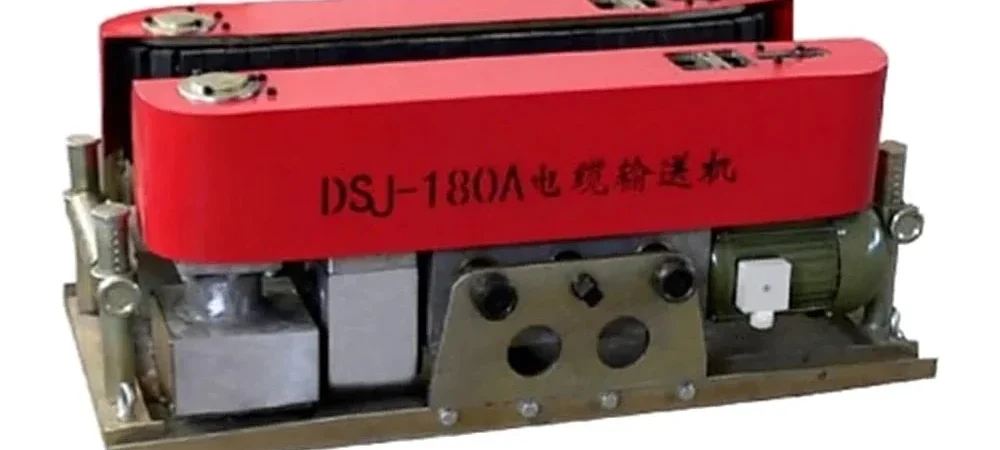
Pulling cable is simple until it is not. A cable pulled too hard stretches and fails. A cable pulled around a sharp edge loses its sheath. A cable pulled without enough rollers drags on the ground and picks up damage that only shows up months later. Choosing the right puller — and the rollers that go with it — is what stands between a clean installation and a fault.
Short answer
Start with three numbers: the cable diameter, the pull force, and the distance. For long steady runs use the DSJ-5 conveyor machine (7 kN, cable 30–180 mm, 9 m/min, 380 V); for short direct pulls use the JJCS-50 winch (diesel 9 kW, 300 kg); protect the cable at tube entries with B series rollers (tube 80–200 mm) and across open ground with SHL1 ground rollers (5 kN, Φ150 mm).
The Job: Pull Without Damage
Cable installation has three enemies: too much pull force, too tight a bend, and friction against the ground or a duct edge. The tools in this guide each answer one of them. A conveyor pulling machine provides steady pull force over a long distance. A hoist winch provides the straight pull for laying and tensioning. Protection rollers guard the cable where it enters a tube. Ground rollers carry it across open ground. Reel stands pay the cable out without kinking it.
Start every choice with three numbers: the cable diameter, the pull force the job needs, and the distance. Everything else follows from those.
The Conveyor Pulling Machine: DSJ-5
For long cable runs — urban power network reconstruction and new cable laying over long distances — the conveyor cable pulling machine is the main tool.
- Model: DSJ-5, Item 21103.
- Motor: 1.1 × 2 kW, supply 380 V.
- Pull force: 7 kN, with clamping force up to 2.7 kN.
- Conveying speed: 9 m/min.
- Cable diameter: 30–180 mm.
- Outline: 950 × 500 × 400 mm, weight 150 kg.
The conveyor grips the cable along its length and pulls it at a steady 9 m/min, which is what a long run needs: even force, no jerks, no local overload on the sheath. Before a long pull, check the conveyor for wear and the clamping force — a worn conveyor will not hold its rated pull. If the cable is outside 30–180 mm, or the pull needs more than 7 kN, the DSJ-5 is the wrong machine.
See the Pullers & Tensioners page.
When to Use a Hoist Winch Instead: JJCS-50
A conveyor machine is for long, steady pulls. A hoist winch is for a straight pull, tight-line work, and cable laying where a winch drum does the work.
- Model: Double Drum Hoist Winch JJCS-50, Item 09162A.
- Engine: diesel 9 kW, 2000 rpm. Power can be configured per requirements.
- Drum: Ø230 mm, outline 1000 × 670 × 600 mm, weight 300 kg.
- Pull speeds: slow 50/5, moderate 25/9 and 14/14, fast 8/22, reverse -/5 and -/9, as printed in the parameter table.
- Uses: tower line traction, tight-line operation, and laying cable.
Use a winch where the pull is short and direct, or where the crew needs to tension a line and hold it. Use the conveyor machine where the cable must travel a long distance at steady speed. If the job needs both, order both and say so in the quote.
Before any pull, check the drums for wear, the diesel engine oil and fuel, and the brake. The catalogue also lists hydraulic pullers and tensioners, fast powered winches, powered winches, rope reels, and a wire take-up machine in the same section — ask our sales team if your pull needs one of those instead.
Rollers: Where the Cable Touches Something
Rollers are cheap insurance. They decide whether the cable survives the places where it touches the ground, a duct, or a tube entrance.
- B series cable protection roller SH80B: tube diameter 80 mm, weight 4.3 kg. The roller can be placed in the tube entrance at any angle and is lockable, with a nylon roller. Use it where cable enters a tube or duct — the edge that cuts sheath is the edge you cannot see. The B series runs from SH80B to SH200B, tube diameters 80 to 200 mm, weights 4.3 to 12 kg.
- Cable ground roller SHL1: rated 5 kN, applicable cable diameter Φ150 mm, weight 5.4 kg, aluminium roller; the SHL1N is the nylon roller version at 3.6 kg. Use ground rollers where cable runs across open ground, spaced so the cable never touches the ground between them. Check the roller for flat spots and the frame for bending.
- Other supports: the same family includes steel plate support versions (SHL1B, SHL1BN, SHL2BN, SHL3BN) and steel pipe support versions (SHL1G, SHL1GN, SHL2GN, SHL3GN), with applicable cable diameters Φ150, Φ160, and Φ200 mm. Match the support to the cable diameter on the product page.
The catalogue also lists C, C1, and D series cable protection rollers, opening protection cable rollers, aerial cable stringing rollers, and hydraulic reel elevators in the same section — ask our sales team if your installation needs one of those.
See the Cable Installation Tools page.
Reel Stands: Pay Out Without Kinking
A puller cannot fix a cable that was already damaged on the drum. Reel stands pay the cable out cleanly: upright payout turntables, conductor reel stands, and large-capacity hydraulic conductor reel stands are listed in the catalogue. Check that the stand matches the drum size and that the drum turns freely before the pull starts.
Choosing the Right Puller: A Short Checklist
- Confirm the cable diameter. The DSJ-5 takes 30–180 mm. Ground rollers are sized by diameter — Φ150, Φ160, or Φ200 mm. Protection rollers are sized by tube diameter — 80 to 200 mm.
- Confirm the pull force. The DSJ-5 pulls 7 kN. If the job needs more, say so — do not overload the machine.
- Confirm the distance and the route. Long, steady runs take the conveyor machine. Short, direct pulls take the winch. Bends and tube entrances take protection rollers; open ground takes ground rollers.
- Confirm the power supply. The DSJ-5 runs on 380 V. The JJCS-50 runs on its own diesel engine.
- Confirm the weight and size for transport. The DSJ-5 weighs 150 kg; the JJCS-50 weighs 300 kg. Check both against your transport before you order.
- Send the list. Cable diameter, pull force, distance, and the models you need. Request a quote and we will price the package per your project.
| Model | Job | Pull force / rating | Size | Speed | Power | Weight |
|---|---|---|---|---|---|---|
| DSJ-5 | Long-distance conveyor pulling | 7 kN (clamping force up to 2.7 kN) | Cable 30–180 mm | 9 m/min | 1.1×2 kW, 380 V | 150 kg |
| JJCS-50 | Straight pull, tight-line work, cable laying | Slow 50 kN, Moderate 25 kN, Fast 8 kN | Slow 5, Moderate 9, Fast 22 m/min | Diesel 9 kW, 2000 rpm | 300 kg | |
| SH80B | Tube-entry protection roller | Tube 80 mm (B series 80–200 mm) | 4.3 kg (B series 4.3–12 kg) | |||
| SHL1 | Ground roller | 5 kN | Cable Φ150 mm | 5.4 kg aluminium; SHL1N nylon 3.6 kg |
Frequently Asked Questions
What cable diameter does the DSJ-5 pulling machine take?
30–180 mm, with a pull force of 7 kN, clamping force up to 2.7 kN, and a conveying speed of 9 m/min, on a 380 V supply.
When do I need a winch instead of a conveyor pulling machine?
Use the JJCS-50 hoist winch for a short, direct pull, tight-line work, or cable laying where a winch drum does the work. Use the DSJ-5 conveyor machine for long cable runs at steady speed.
What is the difference between a cable protection roller and a ground roller?
A protection roller (SH80B and the B series) guards the cable where it enters a tube or duct, and is lockable at any angle. A ground roller (SHL1 and its versions) carries the cable across open ground. Both are sized by diameter — check the product page.
What is the difference between the SHL1 and the SHL1N?
The SHL1 is the aluminium roller version, 5.4 kg; the SHL1N is the nylon roller version, 3.6 kg. Both are rated 5 kN for Φ150 mm cable.
Do you publish prices for cable pulling tools?
No. All products are B2B and priced per project. Request a quote with the item number, model, and quantity, and we will quote for your project.
—
*Browse the ranges on the Pullers & Tensioners and Cable Installation Tools pages.*