Short answer
Pick the hoist by the heaviest single pull — HS-3A at 30 kN, HS-5A at 50 kN, HS-10A at 100 kN, and HS-20A at 200 kN — then match the gripper to the wire type and size for the same pull, and check the chain length (3 m standard, up to 12 m) and the minimum hook distance before ordering.
Introduction
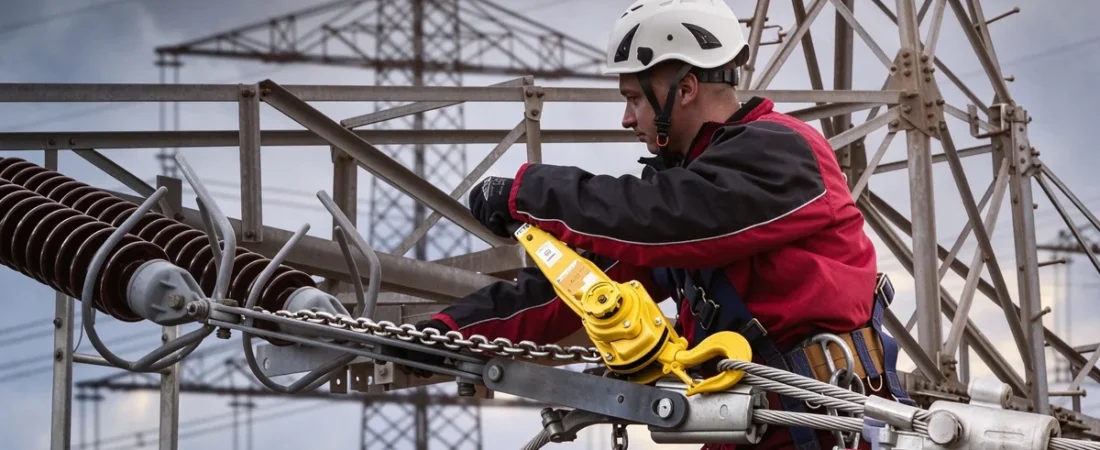
Before a conductor is tensioned and clipped in, somebody has to pull it tight — and on many jobs that pull is done by hand. A manual chain hoist and a come-along clamp are the hand-powered pair for that job: the hoist supplies the pull, and the clamp grips the wire so the pull has something to hold. No engine, no hydraulics, no power supply — just chain, hooks and jaws.
This guide explains the three decisions that matter most — how much pull you need, which gripper matches your wire, and how much chain you need — using the hand hoists and come-along clamps listed on Huailite Power as examples. Every number below comes from the parameter tables on the product pages; prices are quoted per customer and project, not listed online.
Three tools, three jobs
A hand-pulling set is usually three pieces working together:
- The hoist does the pulling. The Manual Chain Hoist HS series is a hand chain hoist: pull the hand chain, the load chain shortens, the load moves. It is the tool for lifting, tensioning and holding a load in place while the crew works.
- The gripper holds the wire. A come-along clamp grips the conductor or earth wire so the hoist can pull it. The SKD Earth Wire Gripper series is the earth-wire gripper in the range, and the landing page lists self-gripping clamps, dual-cam grippers and steel rope grippers alongside it.
- The powered winch takes over when hands are not enough. When the pull is beyond hand tools, the step up is a powered winch such as the Double Drum Hoist Winch JJCS-50, listed in 300 kg and 700 kg variants for tower line construction, traction, tensioning and cable laying. If your pull is anywhere near that range, do not try to stretch a hand hoist to cover it — ask us to confirm the right machine.
Do not mix up the jobs: a hoist without a gripper has nothing to hold the wire with, and a gripper without a hoist has nothing to pull with. Buy them as a set, matched to the same pull.
Start with the pull — then check the hoist
Pick the rated load first: the hoist must cover the heaviest single pull on the job, with margin. The HS series lists four rated loads — HS-3A at 30 kN, HS-5A at 50 kN, HS-10A at 100 kN and HS-20A at 200 kN — so the model number rises with the capacity. Read the rating that matches your pull; a hoist rated below the pull is not a bargain, it is a failed lift.
Then comes the trade-off every buyer should understand: as the rated load rises, so do the chains, the weight and the size. The HS-3A and HS-5A run on 2 load chains; the HS-10A needs 4 and the HS-20A needs 8. Weight with standard chain rises from 27 kg (HS-3A) to 45.5 kg (HS-5A), 83 kg (HS-10A) and 193 kg (HS-20A). The minimum distance between hooks — the shortest the hoist can work in — grows the same way, from 485 mm on the HS-3A to 600 mm, 820 mm and 1,040 mm on the HS-20A.
So buying the biggest hoist “just in case” is the wrong instinct: a 193 kg hoist that needs over a metre of hook-to-hook space is a poor fit for a light tensioning job in a tight spot. If the pull is small, the small hoist is the right tool — lighter to carry, faster to rig, and easier to work with overhead. Step up only when the pull demands it.
How much chain do you need?
Chain length is the second choice, and it is independent of strength: a longer chain does not make a hoist stronger. Every HS model is listed with a 3 m standard chain and 4 m, 5 m, 6 m, 8 m, 10 m and 12 m options. Choose by the distance the load has to travel — the lift height or the take-up on the pull — plus enough slack to rig comfortably.
Two things about long chains deserve attention:
1. Chain is heavy, and the weight adds up. One metre of load chain weighs 9.7 kg on the HS-10A and 19.4 kg on the HS-20A, so a 12 m chain on the big hoist is a substantial extra load for the crew to carry and handle. Order the length you need, not the longest available.
2. Check the working space, not just the length. The minimum hook distance is the shortest span the hoist can close to. If the anchor point and the load are closer together than that distance, the hoist cannot take up the slack. Measure the rigging gap on site before choosing the model.
Match the gripper to the wire — not to the hoist
The gripper is where most selection mistakes happen, because a gripper is rated for a wire type and a wire size, not just a load. Three things must match at once:
1. The wire type. SKD grippers are earth wire grippers, rated for stranded earth wire: SKD25 and SKD35 are rated at 10 kN for GJ25 and GJ35, SKD50 at 15 kN for GJ50, SKD70 at 20 kN for GJ70 and SKD100 at 30 kN for GJ100. The SKDZ self-gripping clamps cover the same kind of work from 5 kN (GJ10–25) up to 50 kN (GJ150–185), and the SKL series covers LGJ conductor from 25 up to 630 at 7–50 kN. For steel wire rope rather than conductor, the SKG steel rope grippers run from 30 kN for Φ9–11 rope up to 200 kN for Φ26–30 rope.
2. The wire size. A gripper’s jaws are made for a diameter range — SKDZ-0.5 takes GJ10–25, SKDZ-5 takes GJ150–185, and the M2000 universal gripper takes Φ4–22 while the M3000 takes Φ16–32. A gripper used on a wire outside its range will either slip under load or damage the wire. If the wire size falls between two models, ask us to confirm the right one rather than guessing.
3. The pull. The gripper’s rated load must cover the same pull as the hoist. The gripper is often the weak link in the set: a 200 kN hoist pulling through a 30 kN gripper is a 30 kN set. Match the two ratings, and check both tables before ordering.
Safe use — the checks that cost nothing
- Never exceed the rated load on either the hoist or the gripper. The table value is the limit for that model, not a starting point.
- Inspect before every use: chain for wear and twisted links, hooks for opening or cracks, gripper jaws for wear and dirt. A jaw that cannot bite cleanly is a slip waiting to happen.
- Keep the pull in line. Side loading a hoist or a gripper loads parts that were not designed for it. Rig so the pull runs straight through the tool.
- Match the gripper to the wire size on the day. Wire sizes vary between spans; confirm the diameter before rigging, not after the gripper slips.
- When in doubt, ask. Send us the wire type and size, the pull required and the working space, and we will confirm the model from the tables before quoting.
What to send us for a quote
Hand hoists and come-along clamps are quoted per customer and project. To get an accurate quote, send us the hoist model and rated load you have in mind — for example HS-5A or HS-10A — the chain length required, the gripper model and the wire type and size it must hold, plus quantity, delivery country and site. Send it to sales@staging.huailitepower.com, or use the contact form, or WhatsApp +86 13049969968. If the tables do not cover your case, say so rather than guessing — we will confirm the model before quoting.
| الموديل | الحمل المقنن | Load chains | Weight with standard chain | Minimum distance between hooks | Chain length |
|---|---|---|---|---|---|
| HS-3A | 30 kN | 2 | 27 kg | 485 mm | 3 m standard; 4, 5, 6, 8, 10, 12 m options |
| HS-5A | 50 kN | 2 | 45.5 kg | 600 mm | 3 m standard; 4, 5, 6, 8, 10, 12 m options |
| HS-10A | 100 kN | 4 | 83 kg | 820 mm | 3 m standard; 4, 5, 6, 8, 10, 12 m options |
| HS-20A | 200 kN | 8 | 193 kg | 1,040 mm | 3 m standard; 4, 5, 6, 8, 10, 12 m options |
FAQ
Can one hoist cover several different pulls?
Within limits, yes — a hoist rated above your heaviest pull can also serve lighter ones. But check the weight and the minimum hook distance: a hoist bought for your heaviest pull may be too heavy and too long-spanned for everyday light work, in which case a second, smaller hoist is the practical answer.
What happens if the gripper does not match the wire size?
It either slips under load or damages the wire. Gripper jaws are made for a stated diameter range, so confirm the wire type and size — for example GJ70 or LGJ240 — before ordering, and match it to the gripper table.
Do you show prices for hoists and clamps online?
No. All products are B2B and quoted per customer and project, depending on model, configuration and quantity. Send the model number and quantity for a quote.
Conclusion
Choose in this order: confirm the heaviest pull, read the rated load at that pull, match a gripper to the wire type and size for the same pull, and check chain length and hook distance against the site. The full range — HS hand chain hoists from 30 to 200 kN, SKD and SKDZ earth wire grippers, SKL conductor grippers and SKG steel rope grippers — is listed on the Come Along Clamps & Hoists page, with a parameter table for every model. Tell us your wire size and your heaviest pull, and we will confirm the model and quote it for your project: sales@staging.huailitepower.com, or WhatsApp +86 13049969968.